Real eigenvalues and eigenvectors of 3x3 matrices, example 3
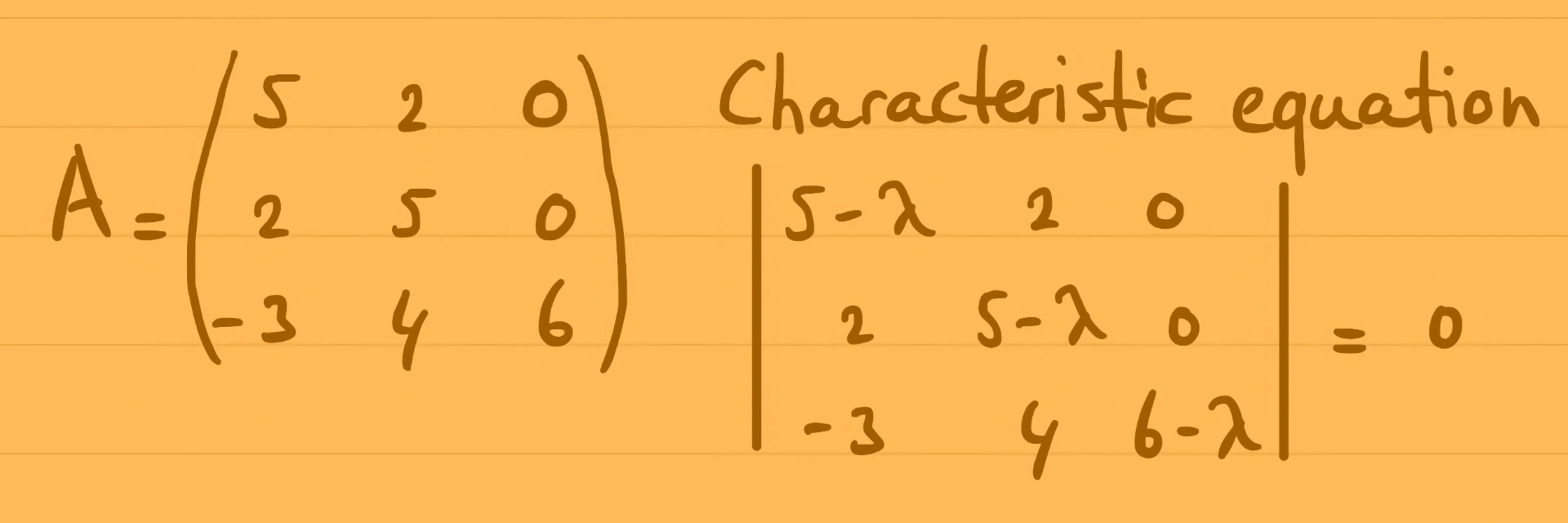

In these examples, the eigenvalues of matrices will turn out to be real values. In other words, the eigenvalues and eigenvectors reside entirely in \(\mathbb{R}^n\).
Suppose we have the following matrix:
\[\mathbf{A} = \begin{pmatrix} \phantom{-}5 & 2 & 0 \\ \phantom{-}2 & 5 & 0 \\ -3 & 4 & 6 \end{pmatrix}.\]
The objective is to determine all eigenvalues and their corresponding eigenvectors.
Characteristic equation
Firstly, we formulate and solve the characteristic equation. The solutions are the eigenvalues of matrix \(\mathbf{A}\).
If \(\mathbf{I}\) is the \(3 \times 3\) identity matrix and \(\lambda\) represents the scalar eigenvalue, the characteristic equation is given by:
\[\det(\mathbf{A} - \lambda \mathbf{I}) = 0.\]
Written in determinant form:
\[\begin{vmatrix} \phantom{-}5-\lambda & 2 & 0 \\ \phantom{-}2 & 5-\lambda & 0 \\ -3 & 4 & 6-\lambda \end{vmatrix} = 0.\]
To compute the determinant efficiently, we expand along the third column because it contains the greatest number of zeros:
\[0 \begin{vmatrix} \phantom{-}2 & 5-\lambda \\ -3 & 4 \end{vmatrix} - 0 \begin{vmatrix} 5-\lambda & 2 \\ -3 & 4 \end{vmatrix} + (6-\lambda) \begin{vmatrix} 5-\lambda & 2 \\ 2 & 5-\lambda \end{vmatrix} = 0,\]
\[(6-\lambda) \begin{vmatrix} 5-\lambda & 2 \\ 2 & 5-\lambda \end{vmatrix} = 0.\]
Evaluating the \(2 \times 2\) determinant:
\[\begin{aligned} (6-\lambda)\left[(5-\lambda)^2 - 2^2\right] &= 0, \\ (6-\lambda)\left[25 - 10\lambda + \lambda^2 - 4\right] &= 0, \\ (6-\lambda)(\lambda^2 - 10\lambda + 21) &= 0. \end{aligned}\]
Factoring the quadratic term yields:
\[(6-\lambda)(\lambda - 3)(\lambda - 7) = 0.\]
The roots of the characteristic equation are immediately apparent:
\[\lambda = 3 \quad \vee \quad \lambda = 6 \quad \vee \quad \lambda = 7.\]
Verifying the eigenvalues
We can verify these eigenvalues by checking the matrix trace and determinant:
- Trace check: The sum of the eigenvalues must equal the trace of \(\mathbf{A}\) (the sum of the main diagonal elements): \[\text{tr}(\mathbf{A}) = 5 + 5 + 6 = 16 \quad \Longleftrightarrow \quad 3 + 6 + 7 = 16. \quad \checkmark\]
- Determinant check: The product of the eigenvalues must equal \(\det(\mathbf{A})\): \[\det(\mathbf{A}) = 6(5^2 - 2^2) = 6(21) = 126 \quad \Longleftrightarrow \quad 3 \times 6 \times 7 = 126. \quad \checkmark\]
Eigenvector equations
To determine the corresponding eigenvectors, let:
\[\mathbf{v} = \begin{pmatrix} x_1 \\ x_2 \\ x_3 \end{pmatrix},\]
satisfying the linear system:
\[(\mathbf{A} - \lambda \mathbf{I})\mathbf{v} = \mathbf{0}.\]
In explicit matrix notation:
\[\begin{pmatrix} \phantom{-}5-\lambda & 2 & 0 \\ \phantom{-}2 & 5-\lambda & 0 \\ -3 & 4 & 6-\lambda \end{pmatrix} \begin{pmatrix} x_1 \\ x_2 \\ x_3 \end{pmatrix} = \begin{pmatrix} 0 \\ 0 \\ 0 \end{pmatrix},\]
which yields the simultaneous system:
\[\begin{cases} (5-\lambda)x_1 + 2x_2 = 0, \\ 2x_1 + (5-\lambda)x_2 = 0, \\ -3x_1 + 4x_2 + (6-\lambda)x_3 = 0. \end{cases}\]
Finding the eigenvectors
Eigenvalue \(\lambda = 3\)
Substituting \(\lambda = 3\) into the system:
\[\begin{cases} 2x_1 + 2x_2 = 0, \\ 2x_1 + 2x_2 = 0, \\ -3x_1 + 4x_2 + 3x_3 = 0. \end{cases}\]
The first two equations reduce to \(x_1 = -x_2\). Substituting this into the third equation:
\[-3(-x_2) + 4x_2 + 3x_3 = 0 \implies 7x_2 + 3x_3 = 0 \implies 7x_2 = -3x_3.\]
Choosing the smallest non-trivial integer solution, setting \(x_2 = -3\) gives \(x_3 = 7\) and \(x_1 = 3\). Thus, an eigenvector corresponding to \(\lambda = 3\) is:
\[\mathbf{v}_1 = \begin{pmatrix} \phantom{-}3 \\ -3 \\ \phantom{-}7 \end{pmatrix}.\]
We verify this via matrix-vector multiplication \(\mathbf{A}\mathbf{v} = \lambda \mathbf{v}\):
\[\begin{pmatrix} \phantom{-}5 & 2 & 0 \\ \phantom{-}2 & 5 & 0 \\ -3 & 4 & 6 \end{pmatrix} \begin{pmatrix} \phantom{-}3 \\ -3 \\ \phantom{-}7 \end{pmatrix} = \begin{pmatrix} 15 - 6 + 0 \\ 6 - 15 + 0 \\ -9 - 12 + 42 \end{pmatrix} = \begin{pmatrix} \phantom{-}9 \\ -9 \\ \phantom{-}21 \end{pmatrix} = 3 \begin{pmatrix} \phantom{-}3 \\ -3 \\ \phantom{-}7 \end{pmatrix}. \quad \checkmark\]
Eigenvalue \(\lambda = 6\)
Substituting \(\lambda = 6\) into the system:
\[\begin{cases} -x_1 + 2x_2 = 0, \\ 2x_1 - x_2 = 0, \\ -3x_1 + 4x_2 + 0x_3 = 0. \end{cases}\]
The first two equations require \(x_1 = 2x_2\) and \(x_2 = 2x_1\), which can only be satisfied simultaneously if \(x_1 = 0\) and \(x_2 = 0\). Because the third equation imposes no constraint on \(x_3\) (\(0x_3 = 0\)), \(x_3\) is a free parameter. Setting \(x_3 = 1\) yields:
\[\mathbf{v}_2 = \begin{pmatrix} 0 \\ 0 \\ 1 \end{pmatrix}.\]
Verification:
\[\begin{pmatrix} \phantom{-}5 & 2 & 0 \\ \phantom{-}2 & 5 & 0 \\ -3 & 4 & 6 \end{pmatrix} \begin{pmatrix} 0 \\ 0 \\ 1 \end{pmatrix} = \begin{pmatrix} 0 \\ 0 \\ 6 \end{pmatrix} = 6 \begin{pmatrix} 0 \\ 0 \\ 1 \end{pmatrix}. \quad \checkmark\]
Eigenvalue \(\lambda = 7\)
Substituting \(\lambda = 7\) into the system:
\[\begin{cases} -2x_1 + 2x_2 = 0, \\ 2x_1 - 2x_2 = 0, \\ -3x_1 + 4x_2 - x_3 = 0. \end{cases}\]
The first two equations state that \(x_1 = x_2\). Substituting \(x_1 = x_2\) into the third equation:
\[-3x_2 + 4x_2 - x_3 = 0 \implies x_2 - x_3 = 0 \implies x_2 = x_3.\]
Hence, \(x_1 = x_2 = x_3\). Setting \(x_1 = 1\) yields the eigenvector:
\[\mathbf{v}_3 = \begin{pmatrix} 1 \\ 1 \\ 1 \end{pmatrix}.\]
Verification:
\[\begin{pmatrix} \phantom{-}5 & 2 & 0 \\ \phantom{-}2 & 5 & 0 \\ -3 & 4 & 6 \end{pmatrix} \begin{pmatrix} 1 \\ 1 \\ 1 \end{pmatrix} = \begin{pmatrix} 5 + 2 + 0 \\ 2 + 5 + 0 \\ -3 + 4 + 6 \end{pmatrix} = \begin{pmatrix} 7 \\ 7 \\ 7 \end{pmatrix} = 7 \begin{pmatrix} 1 \\ 1 \\ 1 \end{pmatrix}. \quad \checkmark\]
References and downloads
- Hero banner: Handwritten mathematics notes by KJ Runia.