Mirror, mirror, what’s up with the mirror writing?


Ever wondered why sentences, words, and letters always exclusively seem to have their left and right reversed in the looking glass, while mirror writing is almost never projected upside down? Things are happening which may not be obvious. For starters, mirrors do not reverse left and right.
We are intelligent types with (sometimes too much) self-awareness. We look in the mirror, and we know it is our reflection and not someone else staring back at us. However, if you were ever under the impression that, for instance, the left and right sides of your face are reversed, you might want to re-evaluate the depth of this appreciation. You are probably still mistaking your mirror image for a real other person facing you. Even though the situations look similar, they are not equal—not just in the metaphysical sense but, more relevantly, in the mathematical sense. This relates to why letters, words, and sentences seem left-right-reversed by the mirror and almost never projected upside down, but we will get to that later.
Mirror Guy
Let’s reflect on the photo below for a moment. The Tie Guy in front of the mirror, trying to tie his tie for a white tie dinner, is looking at himself in the mirror. Who knew? I know, but bear with me, because both peculiarly and crucially, it is important to acknowledge that it is, in fact, himself, and not someone else.

Let’s perform a thought experiment. Imagine Tie Guy drawing a big L on the palm of his left hand and a big R on that of his right:
- Tie Guy has an L on the palm of his left hand and an R on the palm of his right hand;
- Mirror Guy is not someone else: Mirror Guy is Tie Guy;
- Tie Guy presses his left hand with an L against the mirror;
- If a mirror were to reverse Tie Guy’s left and right, Mirror Guy should use the hand with an R, since that is Tie Guy’s right hand;
- Mirror Guy does not: he uses the hand with an L;
- Hence, Tie Guy’s left hand with an L is Mirror Guy’s left hand with an L;
- Therefore, a mirror does not reverse left and right.
Point 6 is probably hardest to grasp at first. Clearly, the Ls of both Guys are up against the mirror. Yet, we still think a mirror reverses left and right. The cognitive hurdle is perhaps that while we accept our mirror image to be us, we are hardwired to continue to treat it as though it were someone else facing us. On a daily basis, chances are we interact more with people facing us than we do with our mirrored selves.
We have grown accustomed to mentally reversing left and right, which evidently has proven to be useful during our interactions with everyday humans. We were taught already at an early age that “your left is her right” or “her left is your right”. Similarly, a mathematical physics professor, upon turning around to face the audience in the lecture hall again, knows all too well that the strings of equations on the blackboard on her left are in fact on her students’ right.
Ironically, left and right get reversed in the real world and not in mirrors. Our left hand is simply our mirror image’s left hand and not “their right”—that is just how the Mirror Universe works.
Transformation
Wait, did I just write “turning around” in italics for a particular reason? Indeed, I did. Turns out, rotations, reflections, and symmetries are tricky. Hence, what follows is an important distinction:
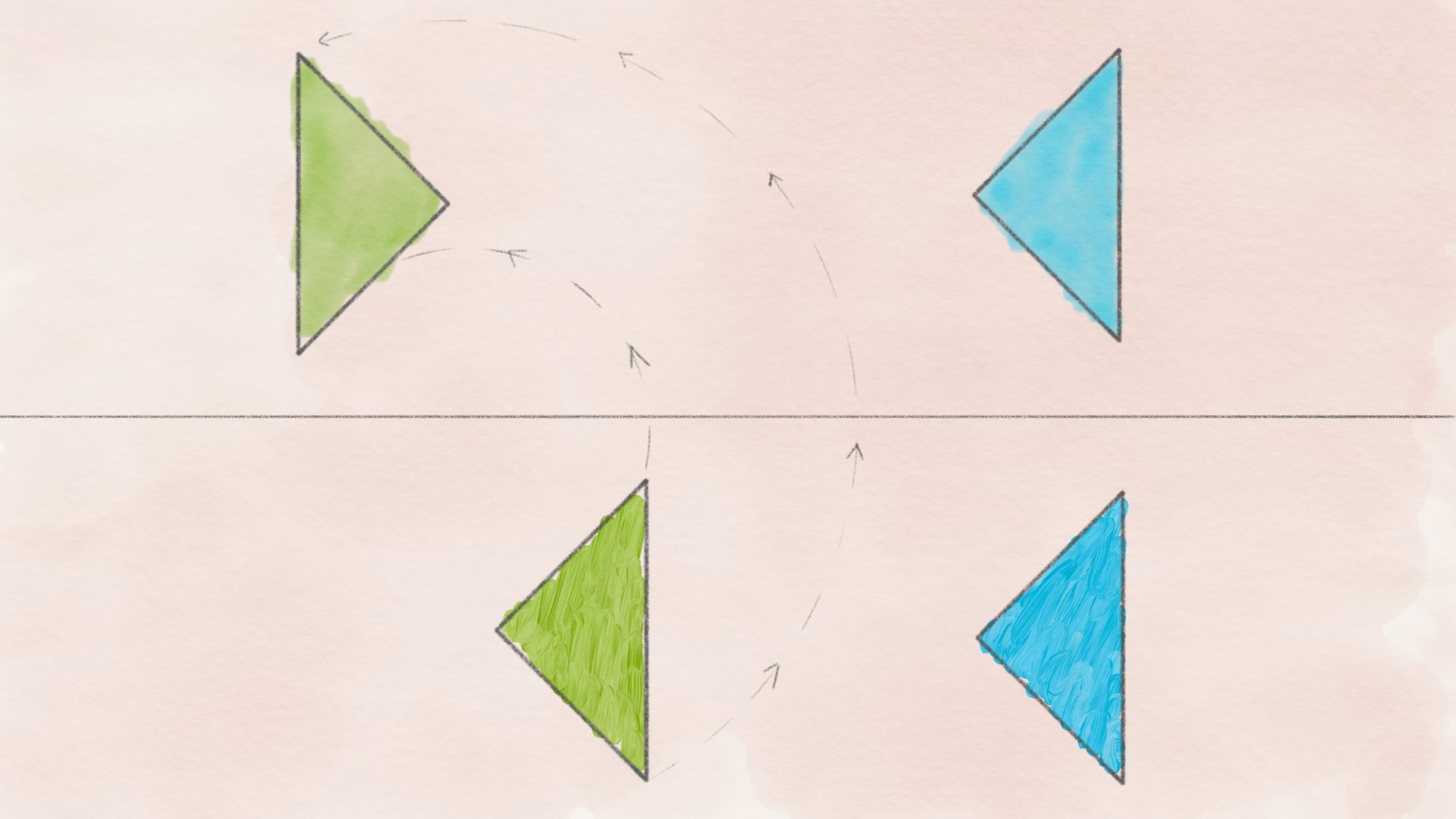
After a rotation of 180°, we need to use the antonym of “left” or “right”, which is not needed in the case of a reflection. However, it is highly plausible one does not encounter reflected human beings very often. We mostly deal with rotated bipeds. So, in the case of looking at your mirror image, you just need to un-think that your mirrored self is someone else: you need to accept that the mirrored self is you.
Funnily enough, accepting that a mirror does not reverse up and down either is a lot easier. Imagine Tie Guy bumping his head against the mirror. Mirror Guy does not then bump his feet against the glass. Therefore, a mirror reverses neither up and down nor left and right.
Why mirrored letters look weird
So, what’s up with mirror writing? Clearly, something is going on with letters, words, and manuscripts, as Leonardo da Vinci knew all too well. Something is going on indeed, but not what you might think. In fact, the mirror has very little to do with it. I blame the opacity of the material we usually write on for our lack of immediate insight.
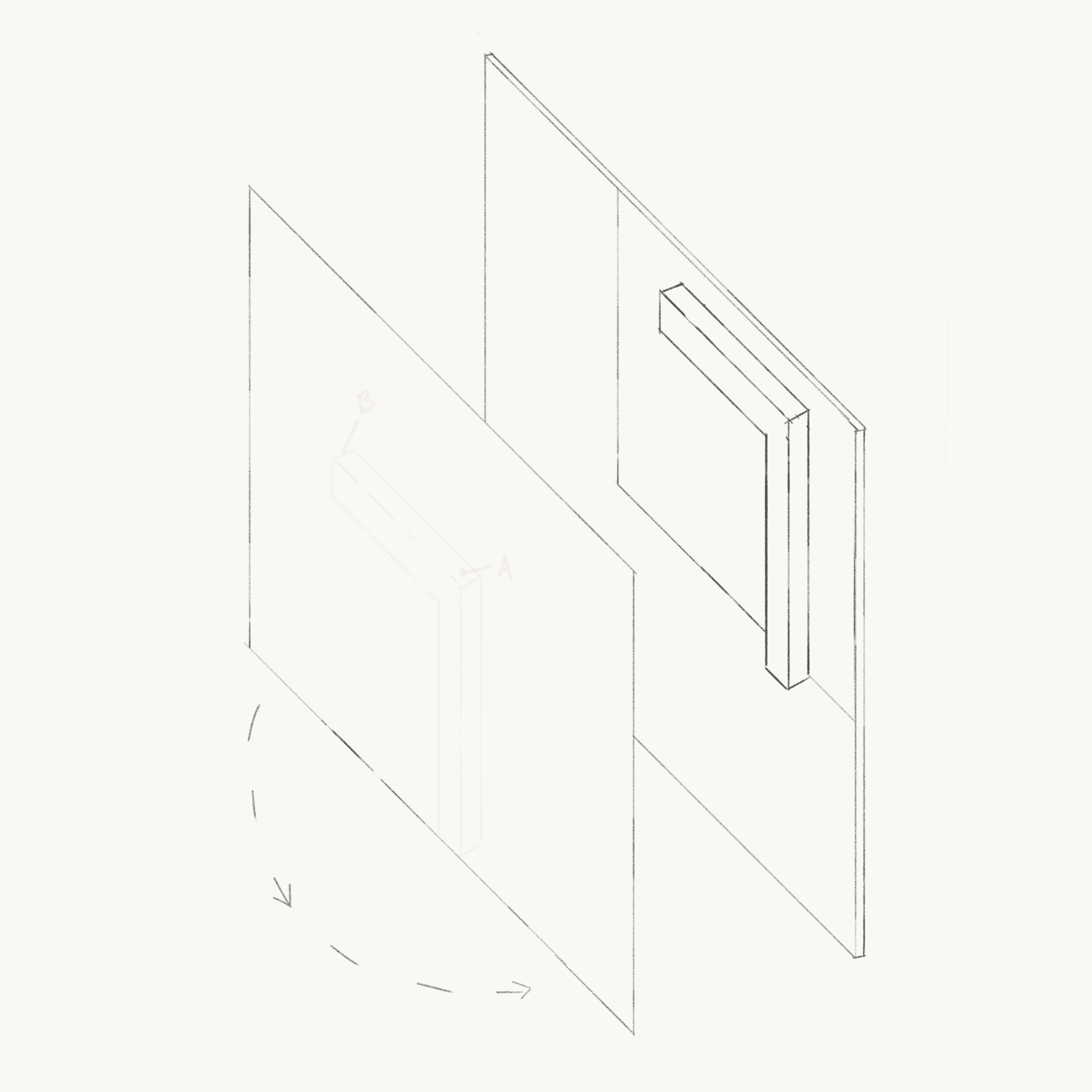
Have a look at Figure 3. We replace a symmetrical human with an asymmetric object resembling the Greek uppercase letter gamma (\(\Gamma\)), which makes reflection easier to visualize.
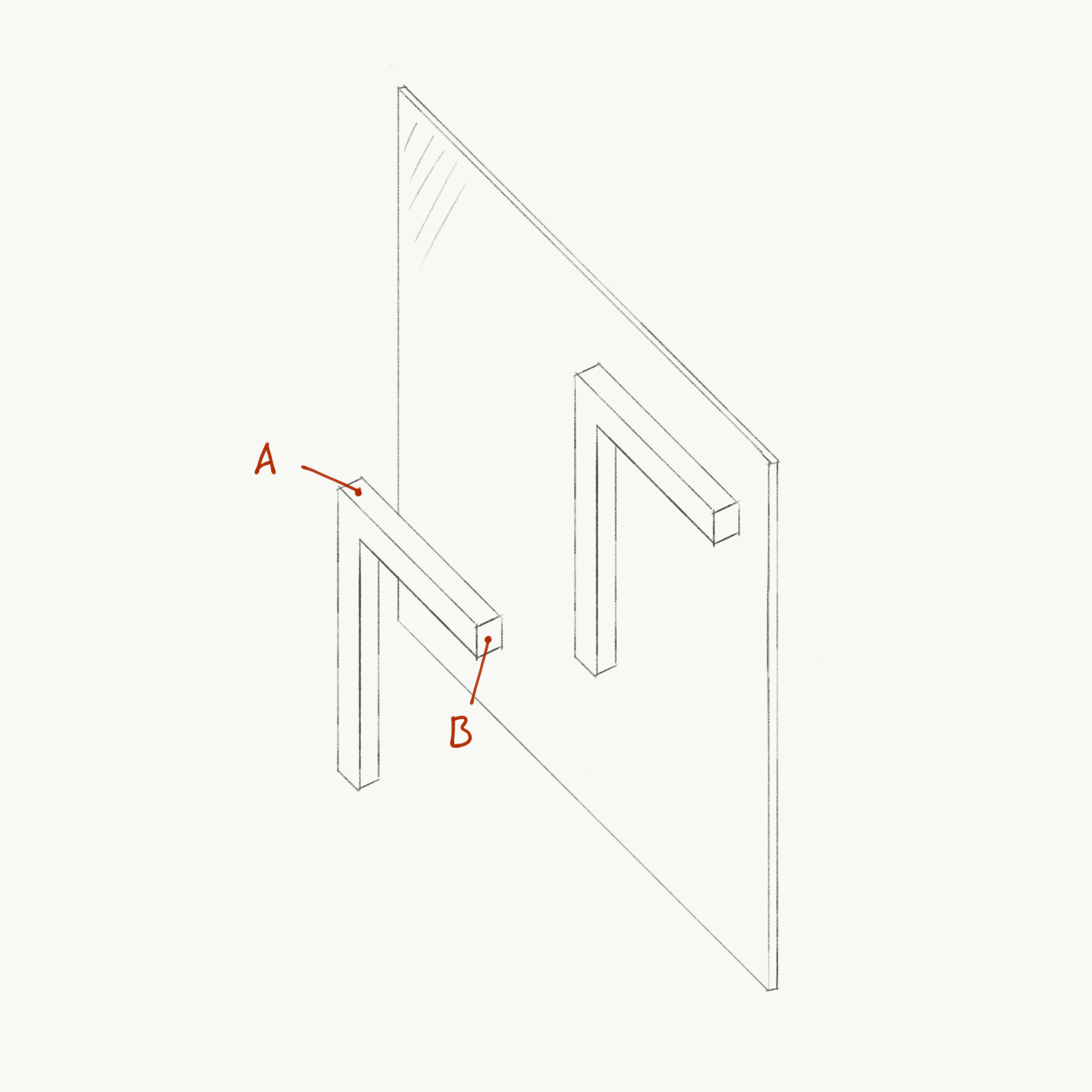
As you can see, points A and B in our original object have not swapped places in the mirrored object. If you imagine yourself standing behind the original object looking at the mirror, point A is on your left and point B is on your right. The exact same is true for the mirror reflection: point A remains on the left and point B remains on the right.
Now imagine the shape of the object being printed onto a large sheet of paper, as drawn in Figure 4.
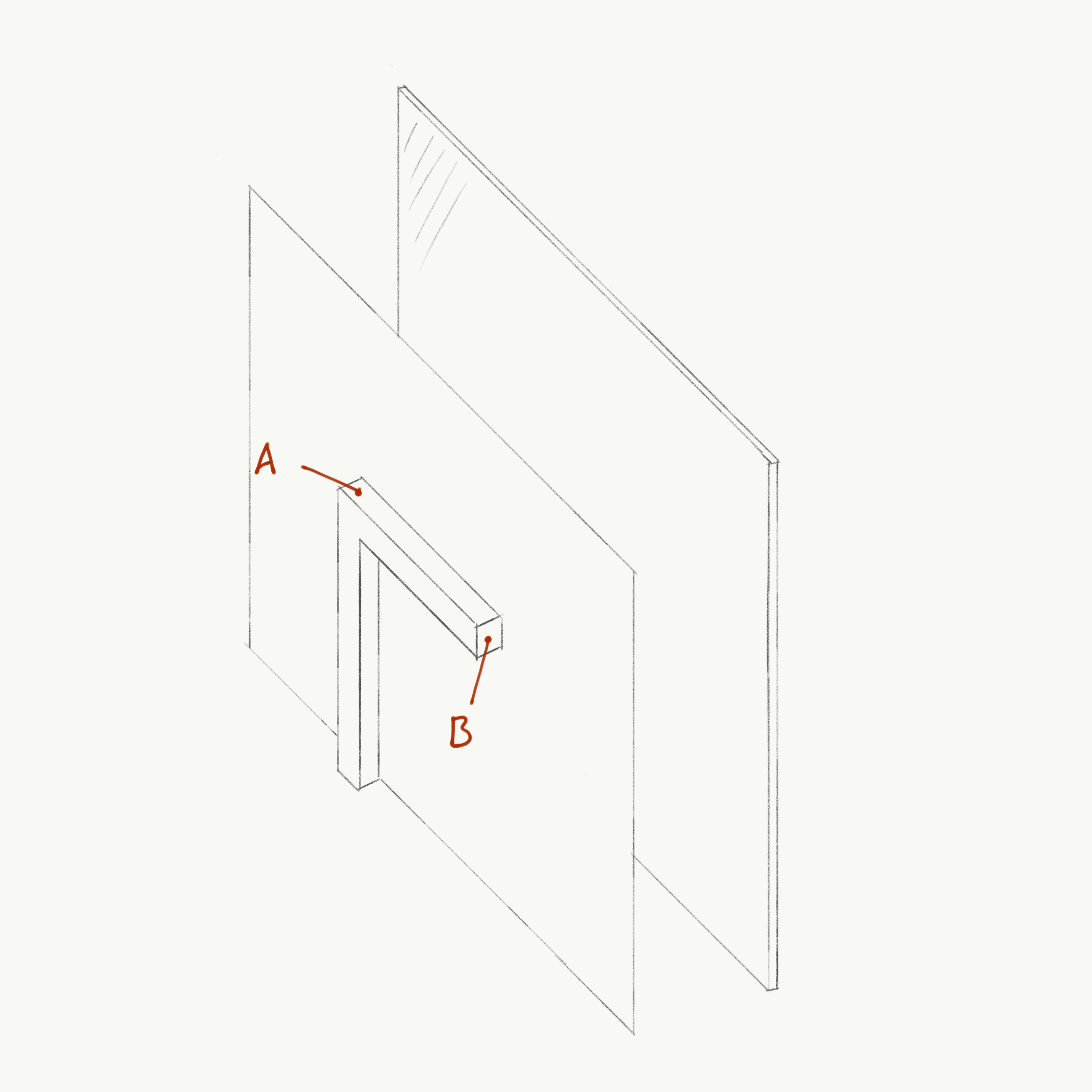
Right now, we have written a letter on a piece of paper, but we cannot see it in the mirror because the back of the opaque sheet blocks the view. What do we naturally do? We turn the paper around to face the mirror.
So, as shown in Figure 5, we rotate the paper. Now look at what happened to points A and B: they have reversed positions! Why? Because you rotated the paper 180 degrees around its vertical axis!
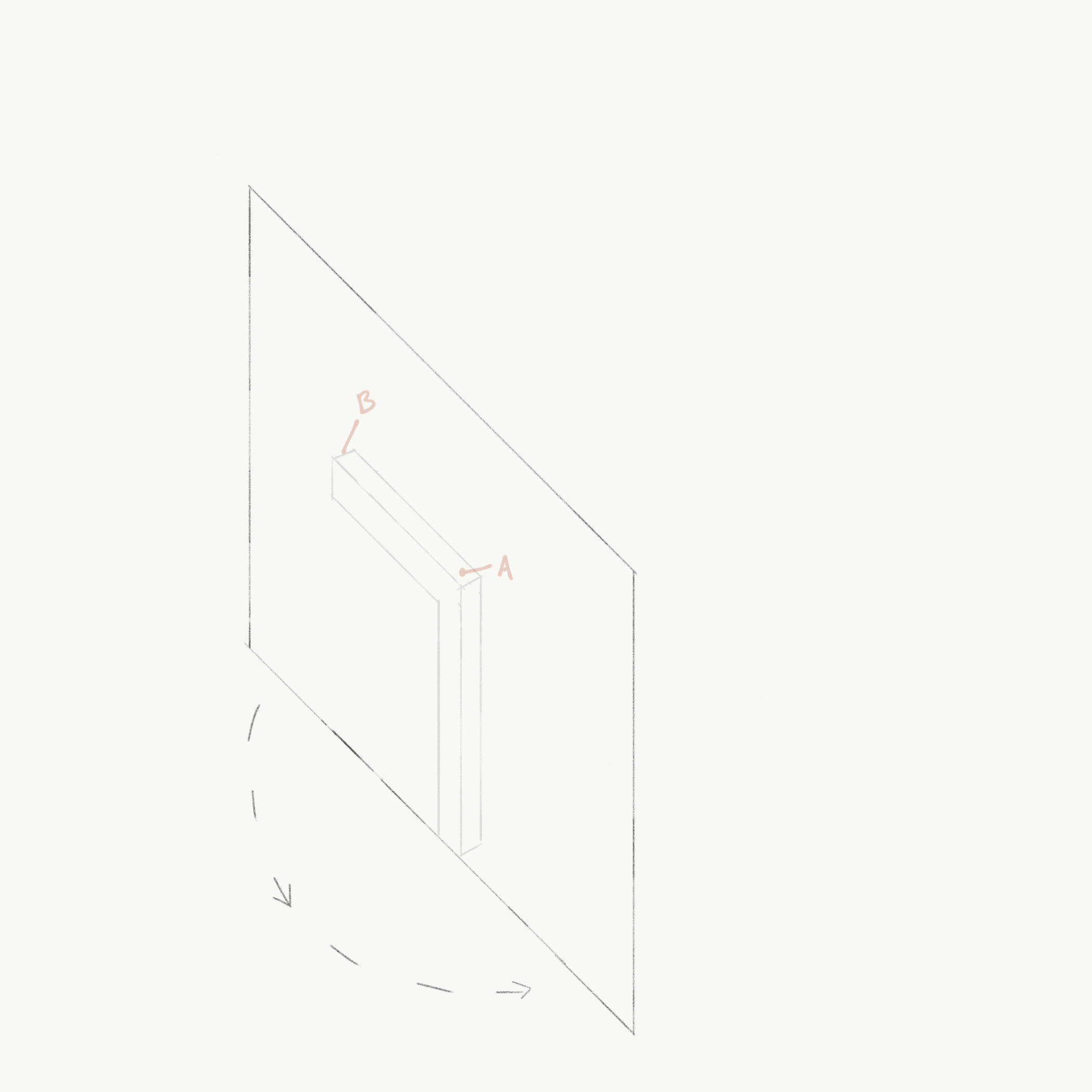
And what does the mirror do? Look at Figure 6: the mirror simply reflects what is presented to it—namely, an already rotated letter.
Conclusion
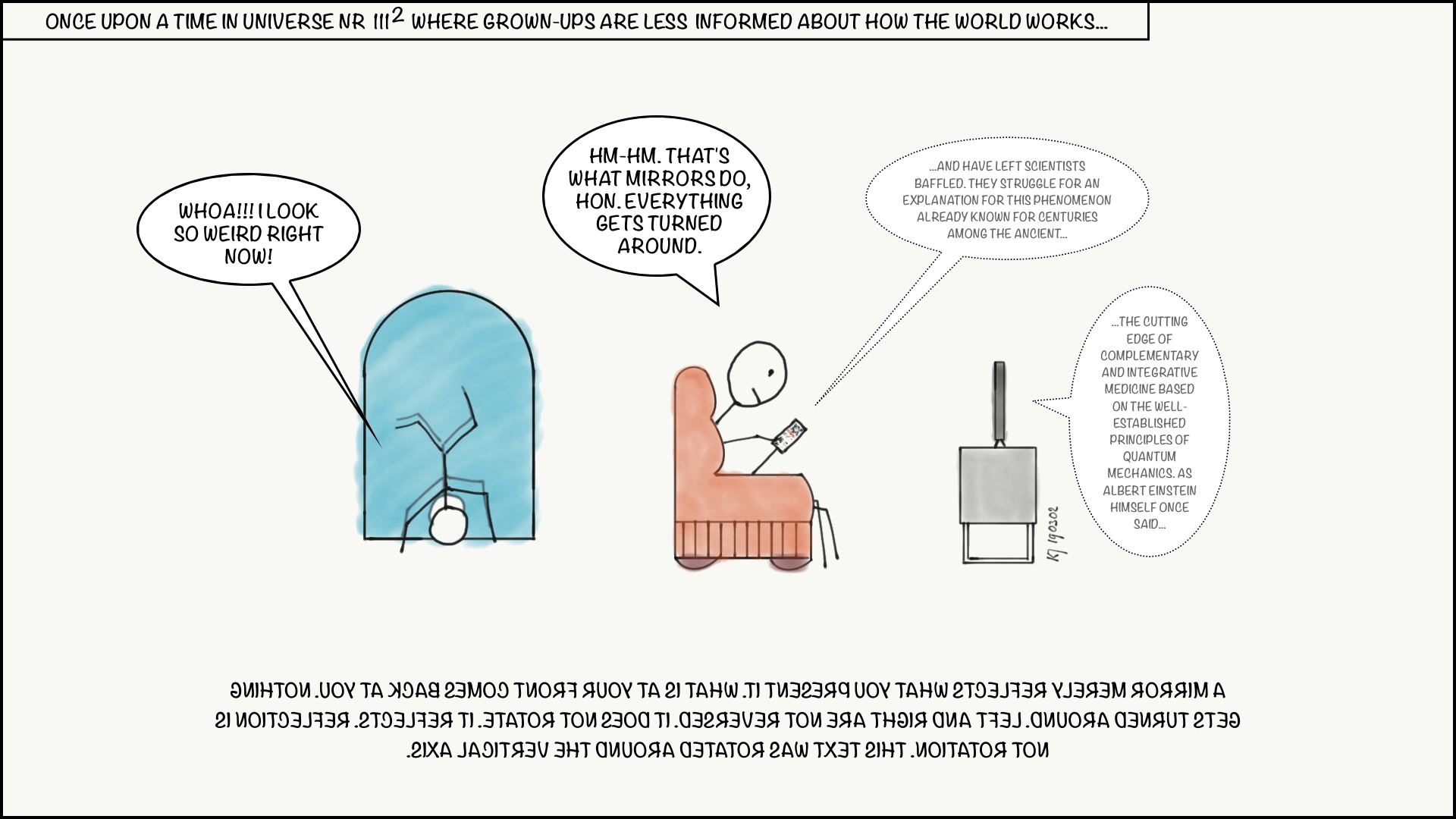
Because humans almost always rotate paper around the vertical axis, it creates the illusion that mirrors selectively flip left and right. Had you flipped the sheet vertically around the horizontal axis (over its top edge), the mirror reflection would appear upside down instead!
Two concluding thoughts to reflect on:
- The way you see yourself in the mirror (reflection) is fundamentally distinct from the way other people see you (rotation).
- To make text look like mirror writing, you do not even need a mirror: simply write on a transparent sheet, rotate it 180 degrees around the vertical axis, and hold it up.
There is no spoon, and there is no magical mirror flipping left and right: it was your own rotation all along.

For completeness: while mirrors do not reverse left and right, nor up and down, they do invert front and back—the orthogonal axis perpendicular to the mirror surface in 3D space. Because flat paper letters have no depth extension along this normal axis, that physical inversion is not what causes text to read backwards.
Image credits and references
- Featured image: Macaque examining its reflection in a motorcycle mirror via Pixabay (CC0 Public Domain).
- Photo of Barack Obama by Pete Souza (White House, Public domain).
- Geometrical coordinate illustrations and editorial cartoon by KJ Runia.
- Film still from The Matrix (1999), Warner Bros.