Finding the normal force in planar non-uniform circular motion using polar coordinates


In this post, we will derive an expression for the normal force on a uniform mass in planar non-uniform circular motion using polar coordinates. Finding this expression is enormously useful for determining under which physical conditions a mass will lose contact and fly off its circular path. Here, we investigate the cylinder-and-string system illustrated below. Obtaining an expression purely in terms of the position angle \(\theta\) is not immediately straightforward: in step 7, we introduce an integration trick to eliminate the second-order derivative \(\ddot{\theta}\).
Notation
We apply Newton’s fluxion notation (dot notation) for compact time derivatives: if \(\mathbf{x}\) is a displacement vector, its first and second time derivatives are written as \(\dot{\mathbf{x}}\) and \(\ddot{\mathbf{x}}\), respectively. Where explicit integration with respect to time is performed, we employ Leibniz’s notation \(\left(\dfrac{\mathrm{d}\mathbf{x}}{\mathrm{d}t}\text{ and }\dfrac{\mathrm{d}^2\mathbf{x}}{\mathrm{d}t^2}\right)\).
Assignment
Consider the mechanical system depicted in Figure 1. A point mass \(m\) is attached to a light, inextensible string draped over a fixed cylinder of radius \(R.\) At \(t = 0\), the mass rests at the horizontal midpoint (\(\theta = 0\)). A constant pulling force \(\mathbf{P}\) is applied vertically downwards to the free end of the string. At time \(t > 0\), the mass slides along the circular surface with a coefficient of kinetic friction \(\mu\). The angle subtended at the centre of the cylinder is denoted by \(\theta\).
Our objective is to calculate the normal force \(\mathbf{N}\) on \(m\) as a function of \(\theta\), and thereby demonstrate that the cylinder’s radius \(R\) does not affect the liftoff criterion.
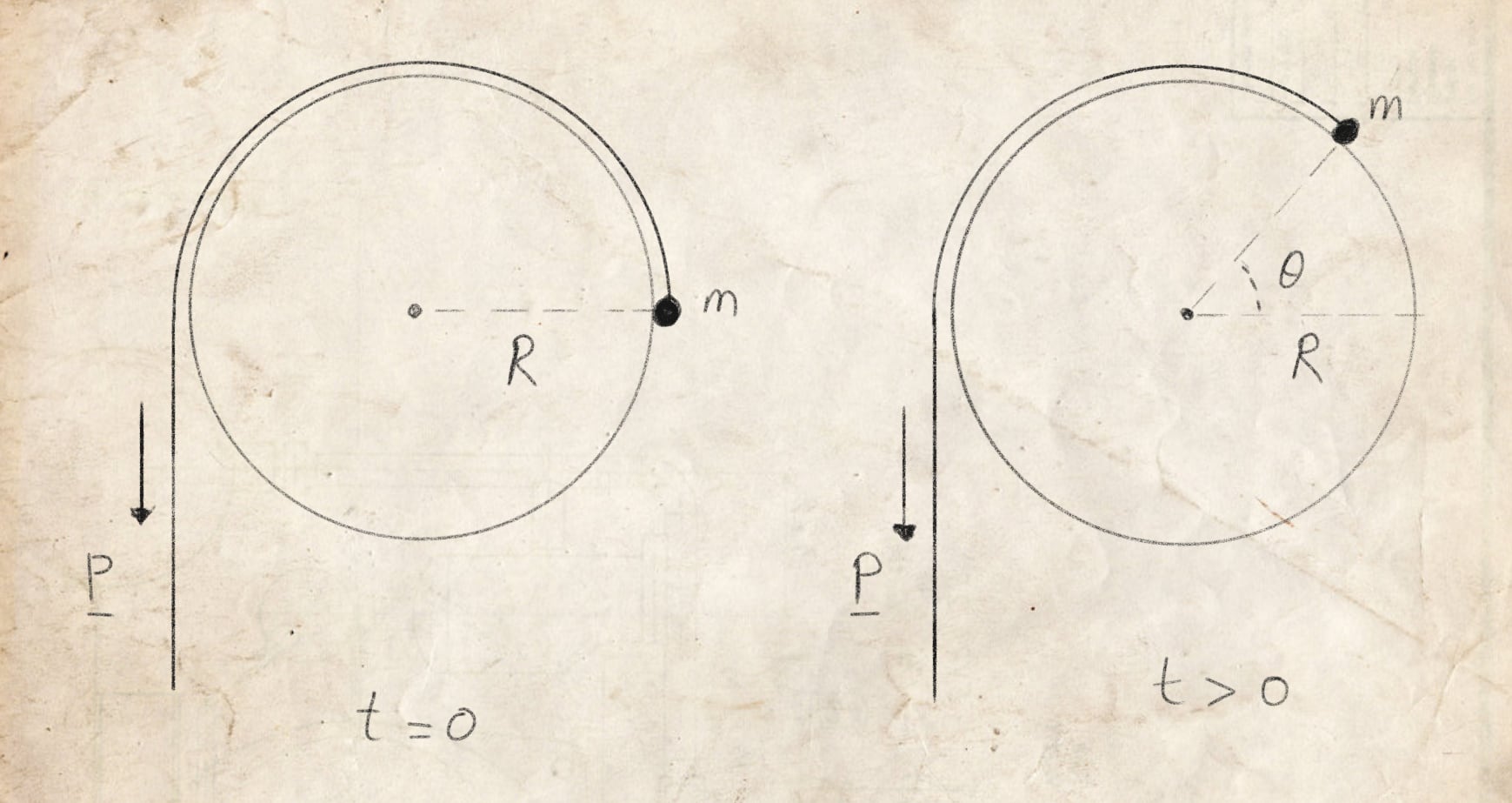
Step 1. Force diagrams and unit vectors
We define our basis using the standard planar polar unit vectors: the radial unit vector \(\mathbf{e}_r\) pointing outwards from the origin, and the tangential unit vector \(\mathbf{e}_\theta\) pointing in the direction of increasing \(\theta\) (Figure 2).
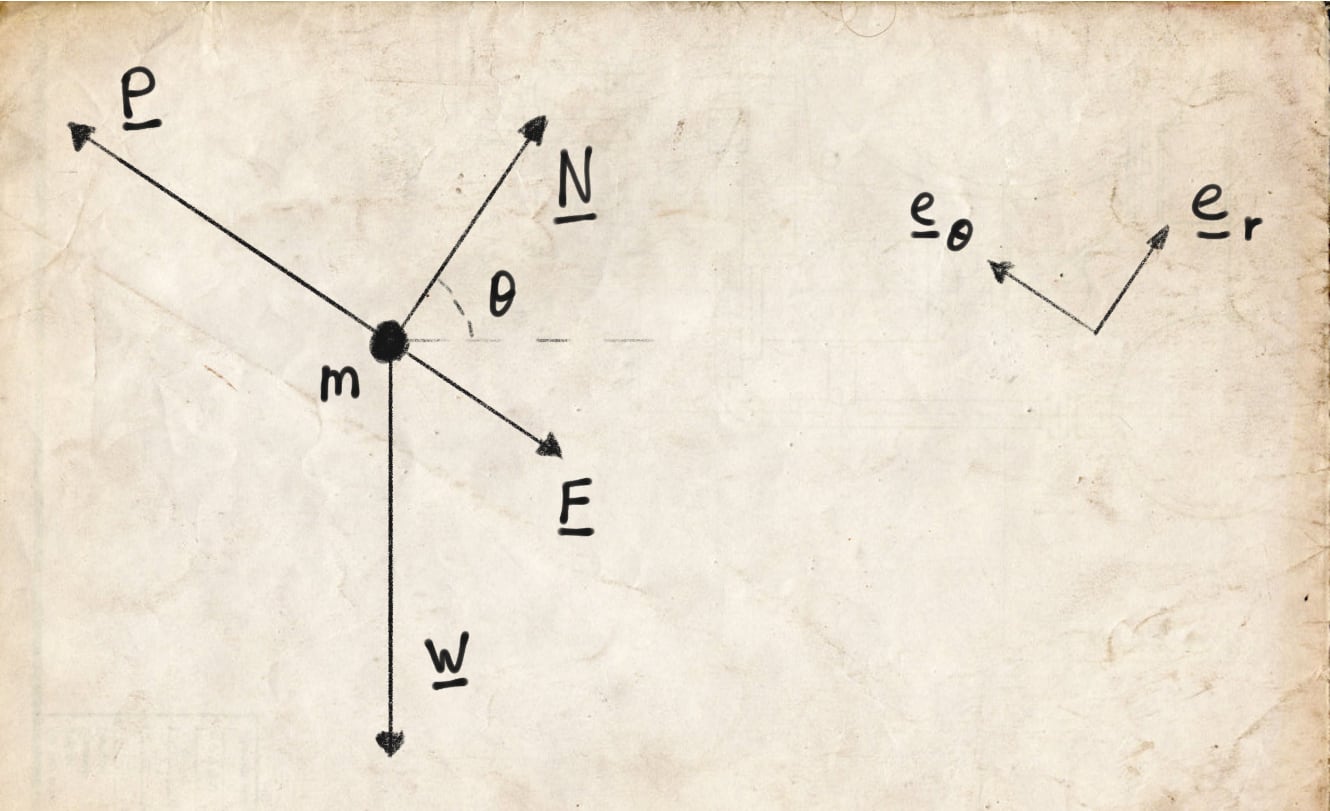
The forces acting on mass \(m\) are:
- \(\mathbf{P}\): the pulling force acting along the string;
- \(\mathbf{N}\): the contact normal force exerted by the cylinder surface on \(m\);
- \(\mathbf{F}\): the frictional force opposing relative motion;
- \(\mathbf{W}\): the gravitational force (weight);
- \(\mathbf{e}_r\): the unit vector in the radial direction;
- \(\mathbf{e}_\theta\): the unit vector in the transverse (tangential) direction.
Step 2. Apply Newton’s second law
Applying Newton’s second law in vector form:
\[\sum \mathbf{F} = m \ddot{\mathbf{r}},\]
\[m \ddot{\mathbf{r}} = \mathbf{P} + \mathbf{N} + \mathbf{F} + \mathbf{W}.\]
Step 3. Express forces in polar components
The string pulls purely in the tangential direction:
\[\mathbf{P} = |\mathbf{P}| \mathbf{e}_\theta = P \mathbf{e}_\theta.\]
The normal force acts purely along the outward normal (radial direction):
\[\mathbf{N} = |\mathbf{N}| \mathbf{e}_r = N \mathbf{e}_r.\]
Kinetic friction opposes the tangential velocity:
\[\mathbf{F} = -\mu N \mathbf{e}_\theta.\]
The downward gravitational weight \(\mathbf{W}\) must be resolved along \((-\mathbf{e}_r)\) and \((-\mathbf{e}_\theta)\) as illustrated in Figure 3:
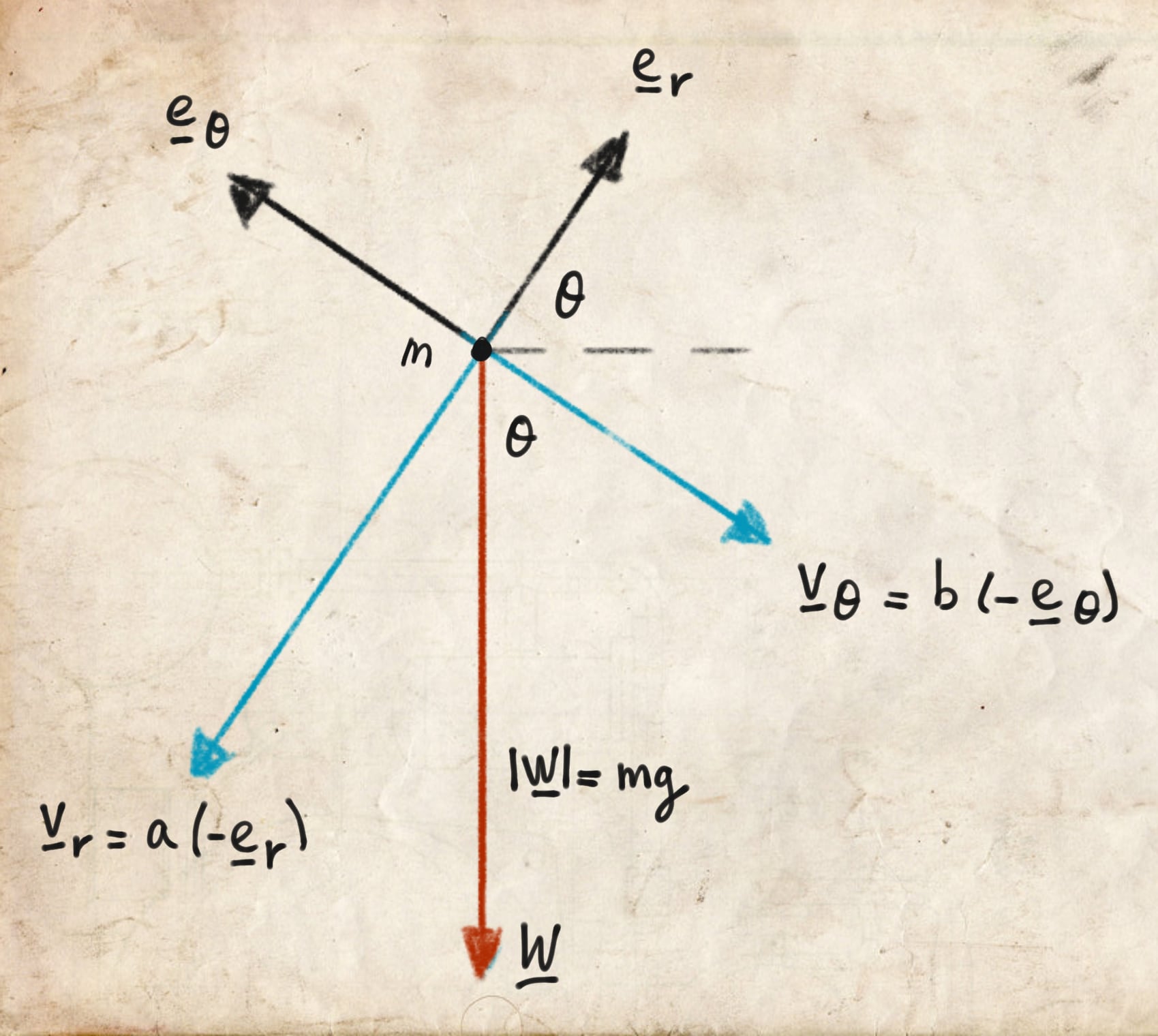
\[\mathbf{W} = -mg \sin\theta \, \mathbf{e}_r - mg \cos\theta \, \mathbf{e}_\theta.\]
Summing all components yields:
\[m \ddot{\mathbf{r}} = (N - mg \sin\theta) \mathbf{e}_r + (P - \mu N - mg \cos\theta) \mathbf{e}_\theta.\]
Step 4. Kinematics in polar coordinates
In planar polar coordinates with a fixed radius \(r = R\) (\(\dot{r} = 0\), \(\ddot{r} = 0\)), the kinematic acceleration is:
\[\ddot{\mathbf{r}} = (\ddot{r} - r\dot{\theta}^2)\mathbf{e}_r + (r\ddot{\theta} + 2\dot{r}\dot{\theta})\mathbf{e}_\theta = -R\dot{\theta}^2 \mathbf{e}_r + R\ddot{\theta} \mathbf{e}_\theta.\]
Multiplying by mass \(m\) and equating with our force decomposition:
\[-m R \dot{\theta}^2 \mathbf{e}_r + m R \ddot{\theta} \mathbf{e}_\theta = (N - mg \sin\theta) \mathbf{e}_r + (P - \mu N - mg \cos\theta) \mathbf{e}_\theta.\]
Step 5. Resolve radially and tangentially
Equating components along each unit vector:
\[\mathbf{e}_r : \quad -m R \dot{\theta}^2 = N - mg \sin\theta,\]
\[\mathbf{e}_\theta : \quad m R \ddot{\theta} = P - \mu N - mg \cos\theta.\]
Step 6. The equation of motion
From the tangential component, the angular acceleration is:
\[\ddot{\theta} = \dfrac{P - \mu N - mg \cos\theta}{m R}.\]
While this provides \(\ddot{\theta}\), substituting it directly into the radial equation is obstructed by the presence of \(\dot{\theta}^2\). We require an analytical expression for \(\dot{\theta}^2\) in terms of position \(\theta\).
Step 7. Integration trick via the chain rule
By applying the chain rule to the time derivative of \(\dot{\theta}^2\):
\[\dfrac{\mathrm{d}(\dot{\theta}^2)}{\mathrm{d}t} = 2\dot{\theta} \dfrac{\mathrm{d}\dot{\theta}}{\mathrm{d}t} = 2\dot{\theta} \ddot{\theta}.\]
Substituting our expression for \(\ddot{\theta}\):
\[\dfrac{\mathrm{d}(\dot{\theta}^2)}{\mathrm{d}t} = 2\dot{\theta} \left(\dfrac{P - \mu N - mg \cos\theta}{m R}\right).\]
Integrating both sides with respect to time \(t\), noting that \(\dot{\theta} \, \mathrm{d}t = \mathrm{d}\theta\):
\[\int \dfrac{\mathrm{d}(\dot{\theta}^2)}{\mathrm{d}t} \, \mathrm{d}t = \dfrac{2}{m R} \int (P - \mu N - mg \cos\theta) \, \mathrm{d}\theta.\]
Carrying out the integration term by term:
\[\dot{\theta}^2 = \dfrac{2P\theta}{m R} - \dfrac{2\mu N\theta}{m R} - \dfrac{2g \sin\theta}{R} + C.\]
Applying the initial conditions at \(t = 0\): \(\theta(0) = 0\) and \(\dot{\theta}(0) = 0\), which sets the constant of integration to \(C = 0\):
\[\dot{\theta}^2 = \dfrac{2P\theta}{m R} - \dfrac{2\mu N\theta}{m R} - \dfrac{2g \sin\theta}{R}.\]
Step 8. Solve for the normal force
Substitute this expression for \(\dot{\theta}^2\) directly back into the radial force balance \(-m R \dot{\theta}^2 = N - mg \sin\theta\):
\[-m R \left(\dfrac{2P\theta}{m R} - \dfrac{2\mu N\theta}{m R} - \dfrac{2g \sin\theta}{R}\right) = N - mg \sin\theta.\]
Expanding the left side:
\[-2P\theta + 2\mu N\theta + 2mg \sin\theta = N - mg \sin\theta.\]
Gathering all terms containing \(N\) on one side:
\[N - 2\mu N\theta = 3mg \sin\theta - 2P\theta,\]
\[N(1 - 2\mu\theta) = 3mg \sin\theta - 2P\theta.\]
Solving for the normal force \(N\):
\[N(\theta) = \dfrac{3mg \sin\theta - 2P\theta}{1 - 2\mu\theta}.\]
Conclusion and liftoff condition
The mass leaves the circular surface when the surface no longer needs to exert contact force to maintain the trajectory, which occurs precisely when \(N(\theta) = 0\):
\[3mg \sin\theta - 2P\theta = 0.\]
As this condition contains only \(m\), \(g\), \(P\), and \(\theta\), the radius \(R\) of the cylinder cancels out completely: the angle at which the mass flies off depends purely on the pulling force relative to weight, entirely independent of the cylinder’s dimensions.
Image credits and references
- Featured image: Coiled mooring rope on rustic wooden decking via Pixabay (CC0 Public Domain).
- Coordinate and free-body diagrams by KJ Runia.