Deriving the volume of the inside of a sphere using spherical coordinates


Even though the well-known Archimedes derived the formula for the volume of a sphere long before modern calculus was born, its derivation using spherical polar coordinates and triple integration is surprisingly absent from many introductory textbooks.
In this post, we derive the classical formula for the volume of a ball:
\[V = \frac{4}{3}\pi r^3,\]
where \(r\) is the radius.
Note the deliberate use of the term ball rather than sphere: in geometry, a sphere denotes the two-dimensional surface boundary embedded in three-dimensional space, which has zero volume. The solid interior enclosed by the sphere is properly termed a ball.
Spherical coordinates
The volume of an infinitesimal Cartesian box \(\delta V\) with sides \(a\), \(b\), and \(c\) is given by \(\delta V = a \times b \times c\).
In spherical coordinates \((r, \theta, \phi)\), an infinitesimal volume element forms a curved differential wedge, as illustrated in Figure 1.
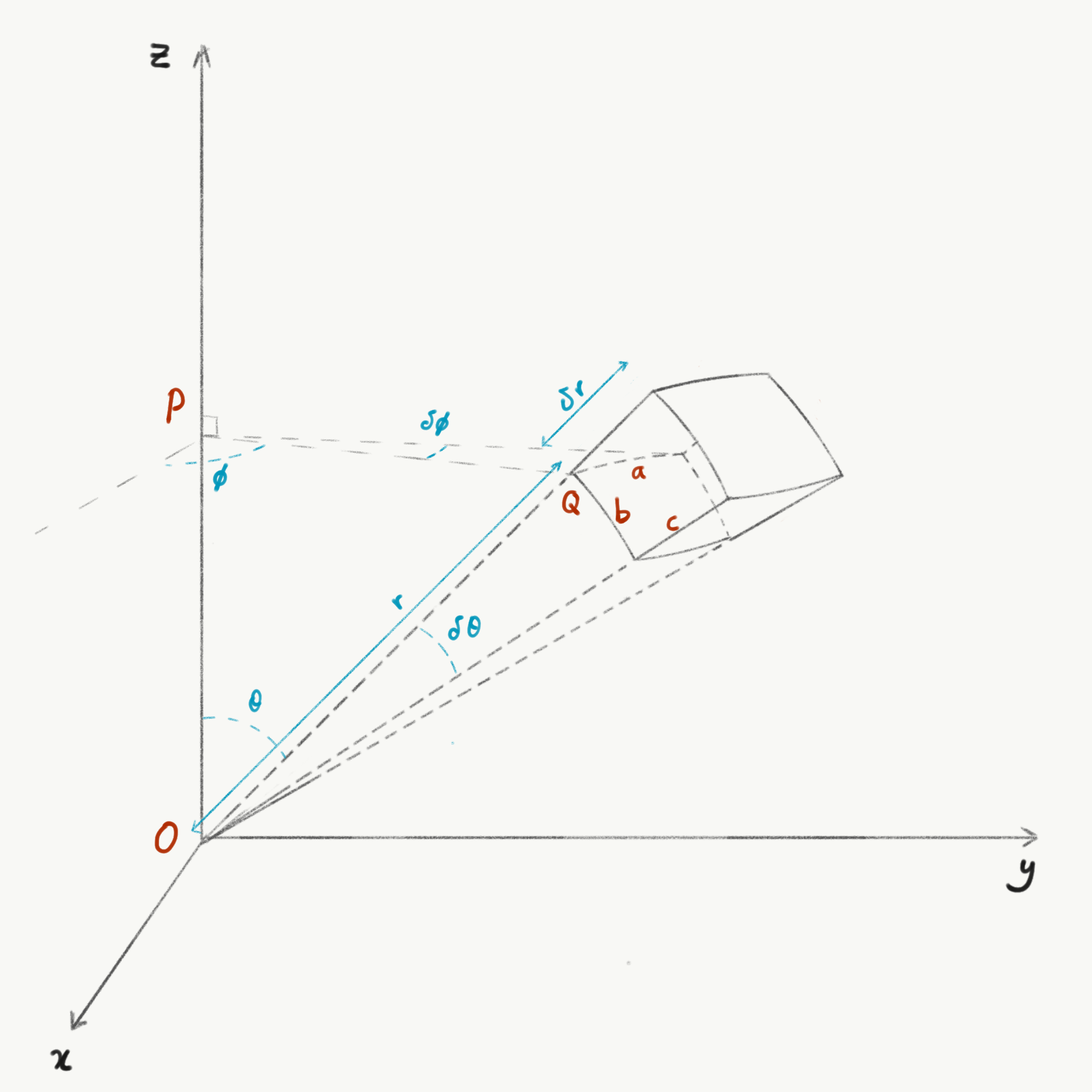
Although its edges are slightly curved, the volume of this element is approximated in the limit by the product of its three orthogonal arc lengths:
\[\delta V \approx a \times b \times c.\]
Using the geometry of spherical polar coordinates:
\[\begin{aligned} a &= PQ \, \delta\phi = r\sin\theta \, \delta\phi, \\ b &= r \, \delta\theta, \\ c &= \delta r. \end{aligned}\]
Multiplying these dimensions together gives the volume element:
\[\delta V \approx (r\sin\theta \, \delta\phi) (r \, \delta\theta) (\delta r) = r^2\sin\theta \, \delta r \, \delta\theta \, \delta\phi.\]
The volume integral
As the increments \(\delta r\), \(\delta\theta\), and \(\delta\phi\) approach zero, this approximation becomes exact. We can therefore formulate the total volume of the ball \(B\) as a triple integral:
\[V_B = \iiint_B \mathrm{d}V = \int_\phi \int_\theta \int_r r^2\sin\theta \, \mathrm{d}r \, \mathrm{d}\theta \, \mathrm{d}\phi.\]
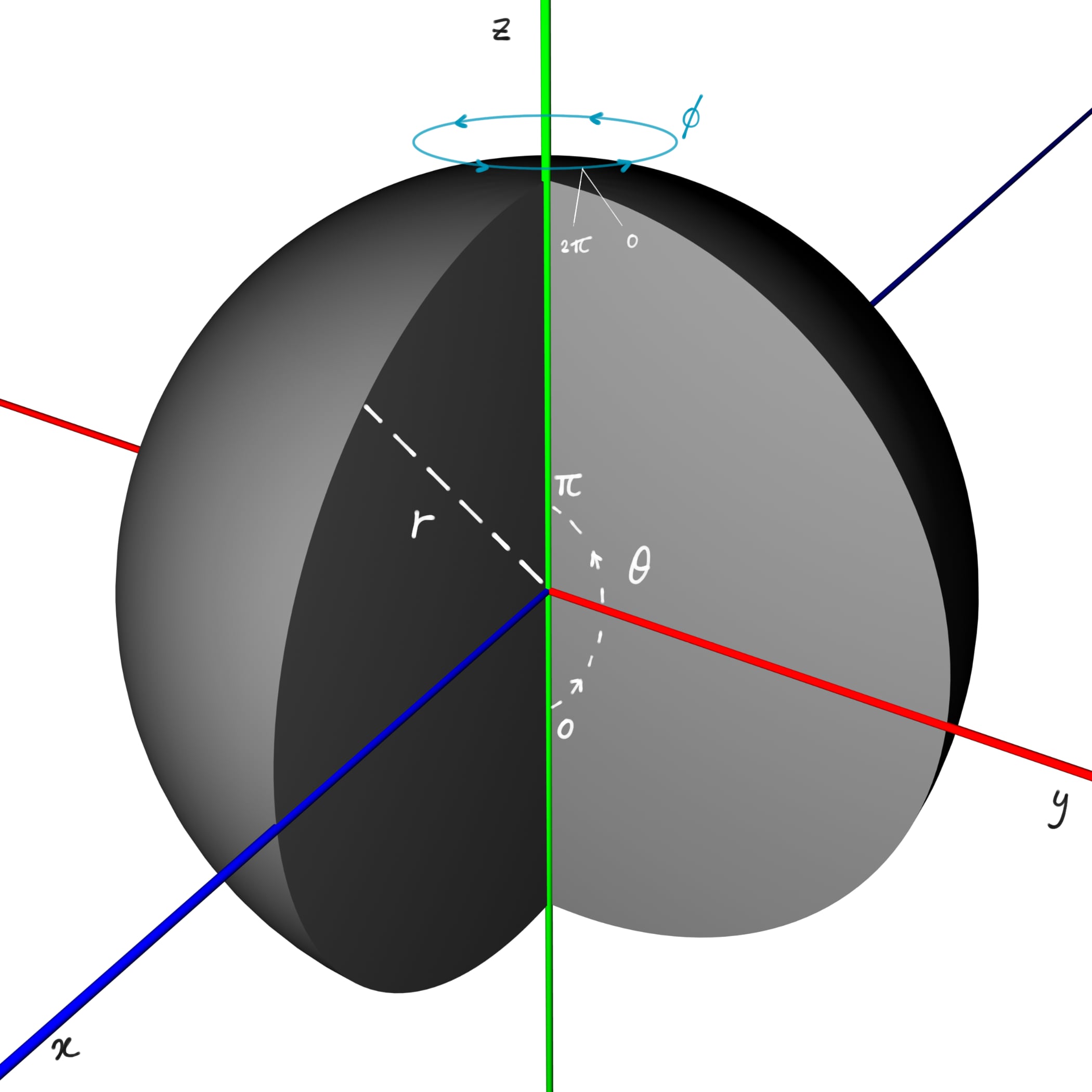
To integrate over every interior point of the solid ball, we set the integration limits by exploiting its rotational symmetry (Figure 2):
- Radial coordinate (\(r\)): extends from the centre at \(r = 0\) out to the boundary surface at \(r = R\) (or \(r\)).
- Polar angle (\(\theta\)): sweeps from the positive \(z\)-axis downwards to the negative \(z\)-axis, spanning the range from \(\theta = 0\) to \(\theta = \pi\).
- Azimuthal angle (\(\phi\)): completes a full revolution around the \(z\)-axis, spanning \(\phi = 0\) to \(\phi = 2\pi\).
Setting these boundaries yields:
\[V_B = \int_0^{2\pi} \mathrm{d}\phi \int_0^\pi \sin\theta \, \mathrm{d}\theta \int_0^r r'^2 \, \mathrm{d}r'.\]
Because the limits of integration are independent constants, the triple integral factors into the product of three independent single integrals:
\[V_B = \left( \int_0^{2\pi} \mathrm{d}\phi \right) \left( \int_0^\pi \sin\theta \, \mathrm{d}\theta \right) \left( \int_0^r r'^2 \, \mathrm{d}r' \right).\]
Evaluating each integral separately:
\[\int_0^{2\pi} \mathrm{d}\phi = \Big[ \phi \Big]_0^{2\pi} = 2\pi,\]
\[\int_0^\pi \sin\theta \, \mathrm{d}\theta = \Big[ -\cos\theta \Big]_0^\pi = -(-1) - (-1) = 2,\]
\[\int_0^r r'^2 \, \mathrm{d}r' = \left[ \frac{1}{3}r'^3 \right]_0^r = \frac{1}{3}r^3.\]
Multiplying the evaluated factors:
\[V_B = (2\pi) \times 2 \times \left(\frac{1}{3}r^3\right) = \frac{4}{3}\pi r^3.\]
This completes the derivation of Archimedes’ classic formula using spherical coordinates and multivariable calculus.
Image credits and references
- Featured image: Globe detailing the Arctic region and meridian ring via Pixabay (CC0 Public Domain).
- Coordinate geometry illustrations and 3D spherical diagrams by KJ Runia.